
Body tube
The body tube carries the rocket’s parts and leaves space for its payload and recovery system.
What is it?
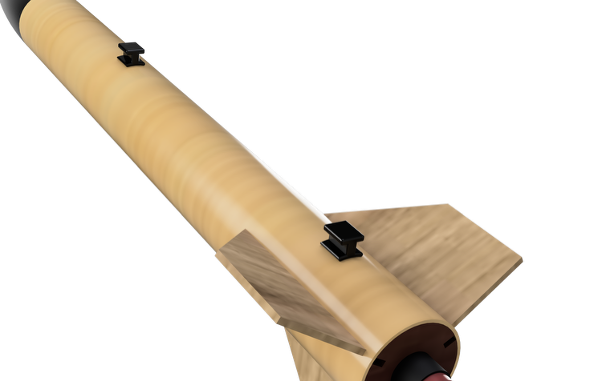
The The central tubular part of the rocket’s airframe. is the central part of the rocket’s airframe. It supports the nose cone, fins and rail guides and encloses the payload, recovery equipment and motor mount. Strong paper or cardboard tubes are common for model rockets; the motor normally sits in a smaller body tube inside the main body tube.
Requirements
The tube must be straight, light and strong enough for flight and landing loads, with square ends and correctly fitting joints. Allow room for the egg and all its cushioning, the packed recovery system and the motor mount, while leaving the parachute a clear path out.
Common problems
Bent tubes and crushed ends weaken the airframe and spoil alignment; paper and cardboard also suffer water damage. Confusing inside and outside diameters produces ill-fitting internal parts, while a narrow payload bay can squeeze the padding or obstruct recovery.
Buying it
It is highly recommended to buy your body tube, preferably from a specialist rocketry shop. This keeps it within a recognised size range and makes it easier to find matching nose cones, couplers and centring rings. UKRA’s list of UK vendors is a useful starting point.
Postal tubes can also be used, but their dimensions follow a different standard. Purchased rocket nose cones and couplers are unlikely to fit, so measure carefully and plan for custom parts.
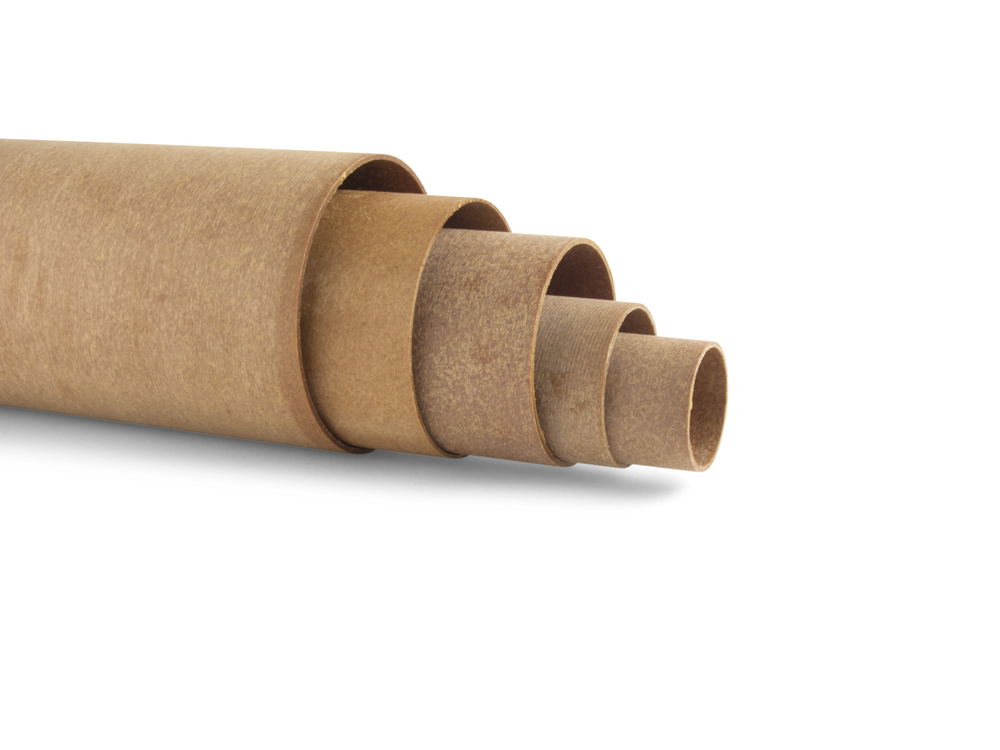
Rocketry tubes are commonly sold in inch sizes, including whole- and half-inch sizes such as 2 in, 3 in, 3.5 in and 4 in, depending on the range. In many inch-based ranges, this describes the nominal inner diameter. Tubes can also be listed in millimetres, and some ranges use the outer diameter for their stated size. Size names and conventions may vary between manufacturers, so always check the units and both the inside and outside diameters before choosing matching parts.
This matters when you simulate the rocket and choose parts that fit inside it. For example, Black Cat Rocketry’s 3-inch tube has a 76.2 mm inside diameter and a 79.2 mm outside diameter. Enter the outside diameter in OpenRocket’s outer-diameter field, then the measured inside diameter or wall thickness. Wall thickness is half the difference between the two diameters.
A coupler tube is named for the body tube it fits. Within a compatible range, a 3-inch coupler fits inside a 3-inch body tube; the coupler’s outside diameter is slightly smaller than the body tube’s inside diameter. Buy both from a matching range and check the fit before gluing.
Rocket motors are made to fit inside body tubes, with motor diameters usually given in millimetres. A 24 mm motor fits a 24 mm body tube: the motor’s outer diameter matches the body tube’s inner diameter. This is how we make a motor mount: use a body tube that fits the motor and support it inside the main body tube with centring rings.
Try it in OpenRocket
Follow the two slides below to add a body tube in OpenRocket. The practice length is 450 mm; replace the example dimensions, material and mass with those of your actual tube. Check the units before entering each measurement.
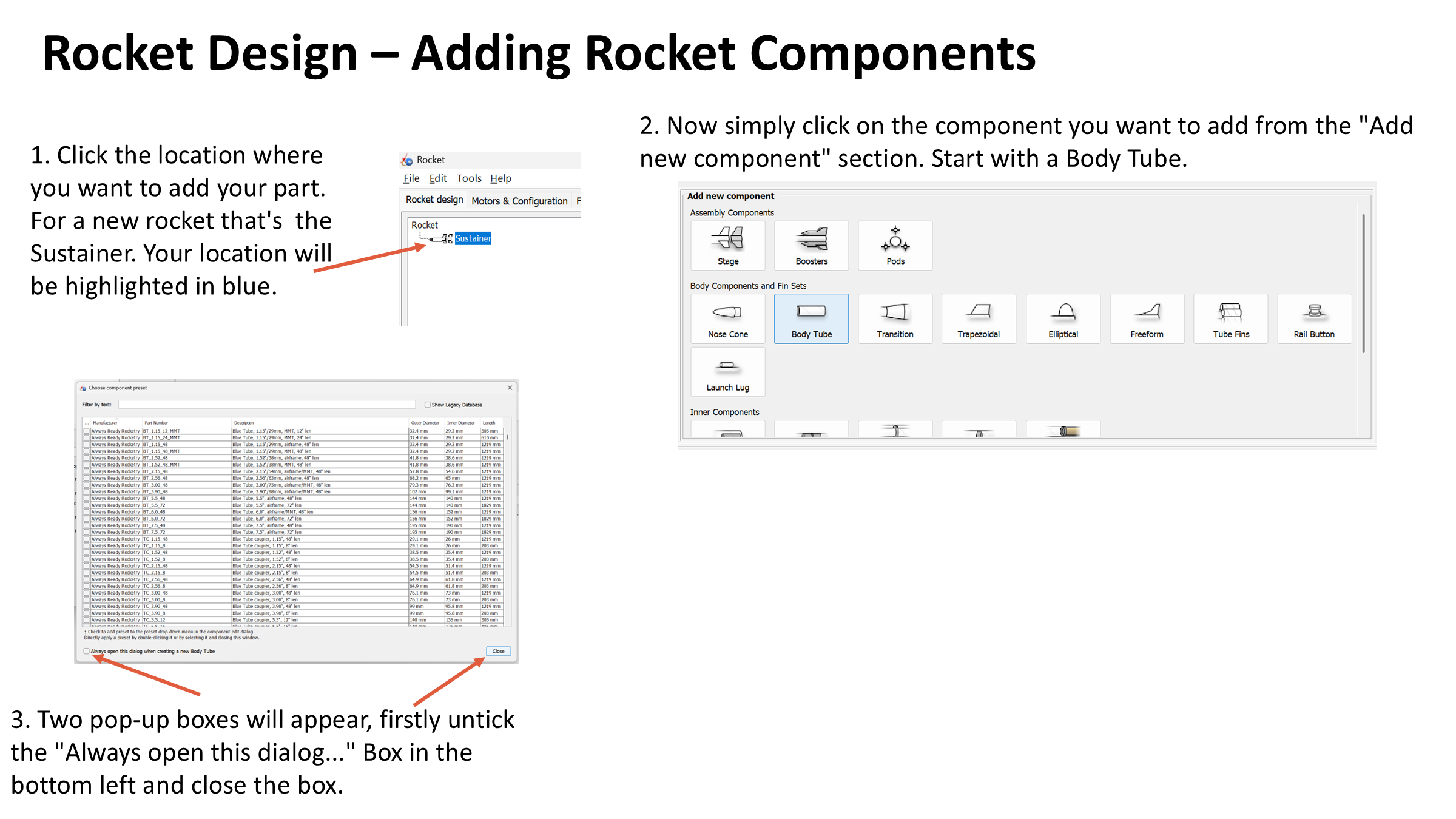
1. Select the location for the new part: Sustainer for a new rocket. It is highlighted in blue. 2. Choose Body Tube under Add new component. 3. In the preset dialog, untick Always open this dialog and close it.
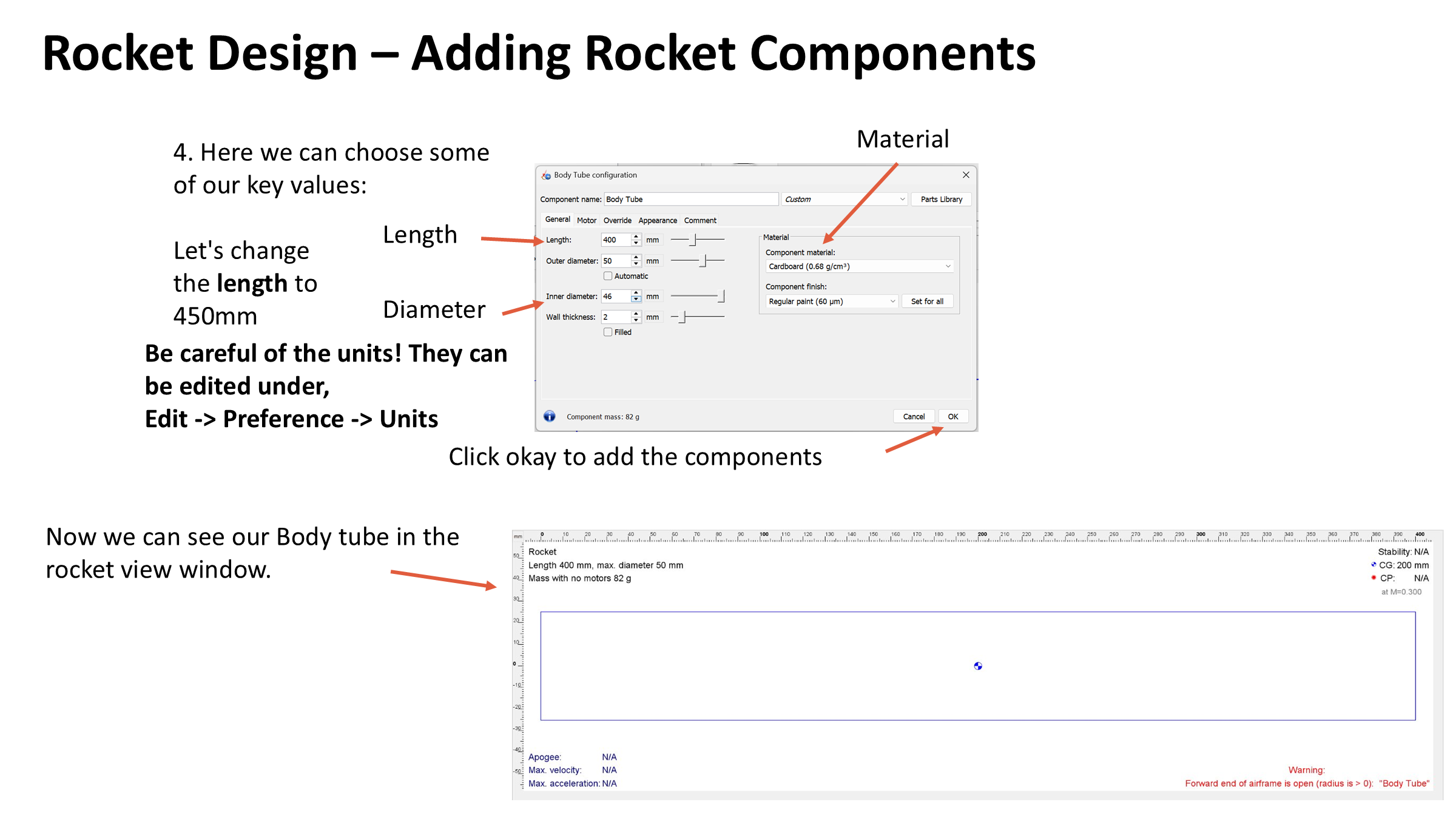
4. Change the practice length to 450 mm. Set the actual diameters and material. Check the units under Edit, Preferences, Units. Click OK to add the component. The body tube now appears in the rocket view.