

Payloads

Climate Science payloads

As part of the Launch 4 Change mission, we aim to inspire talented university students to pursue careers in climate science while making meaningful contributions to the field. Each university team will design a climate science payload and launch vehicle focused on an area of research they believe will be most valuable. A payload is the scientific package carried aboard a rocket to collect meaningful data during flight; as the rocket ascends, it measures changing atmospheric conditions and builds a vertical profile of key environmental variables that cannot be captured from the ground alone. These measurements provide a snapshot of how the atmosphere changes with altitude, offering deeper insight into climate, weather and environmental processes. Each participating university is responsible for designing and building its own flight-ready payload, which will be launched on a dedicated rocket at the Launch 4 Change event in August to gather unique scientific data during ascent and descent.

University Climate Science Payloads

Each university has a timeline overview as well as their own dedicated payload page. Select one below to view  and use the the find out more button the full breakdown.

ATMOS project YEAR 1

Key Measurements

ATMOS (Aerosol, Temperature, Methane, ozone system) started as an idea to measure complete atmospheric data in compact inexpensive payload. Providing the ability to produce a large number of vertical profile to build a better understanding of our atmosphere and climate change. The first goal was to measure the core atmospheric variables that already have sutable commercially available sensors, the payload was designed to record carbon dioxide, ozone, temperature, barometric pressure, and flow rate. These measurements formed the foundation of the project, allowing us to test both the sensing concept and the practicality of collecting vertical atmospheric data during a rocket mission.

Expected Vertical Profiles

A key aim of the project was not just to record single measurements, but to begin building up a vertical picture of the atmosphere. By collecting data throughout ascent and descent, ATMOS was intended to provide altitude-dependent profiles of atmospheric conditions. These vertical profiles could eventually help reveal how quantities such as temperature, humidity-related structure, gas concentration, and aerosol properties vary with height. In the long term, this would support the broader goal of understanding aerosol behaviour and improving low-cost atmospheric sampling methods.

Launch and First Results

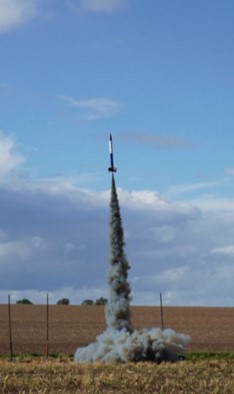
The first ATMOS flight provided an important proof of concept. The payload was successfully launched and recorded atmospheric data throughout the mission, reaching an altitude of around 600 m. The pressure data performed especially well, showing the expected relationship with altitude and confirming that the sensor was working accurately. The flow-rate data also showed that the inlet system was successfully drawing in external air, although periodic fluctuations revealed the effect of rocket spin during flight. Temperature data was noisier than hoped, and the CO₂ sensor showed only a weak trend, indicating areas for improvement in future designs. Overall, the launch demonstrated that the ATMOS platform could operate in flight and collect meaningful environmental data, providing a strong foundation for the second year of development.

ATMOS Project Year 2

Introducing Digital Holography

Aerosols are tiny particles floating in the air. They affect air quality, clouds, and
climate. To understand the effects better, we want to know the size and type of
aerosol in a vertical profile.

Digital holography is a way of doing this with light. A laser shines through the air, and some light is scattered by particles into the sensor forming a hologram. A computer can then use this hologram to rebuild an image of the particles [1].

This is useful because it can show the size and shape of particles without needing to collect them first.

From Holograms to images

To turn a hologram into an image, we use an inverse Fourier transform written as,

where U (x, y, z) is the rebuilt image and Icon(x, y) is the recorded hologram.
In simple terms, this equation lets the computer revers the effects of scattering.

Aerosol Imaging and Vertical Profiling

Digital holography does more than count particles. It can also show what they look like.

We can use this to try identify aerosols by there shapes and sizes. Some examples here.

CAD of ATMOS Payload Layout & Launch Vehicle

yEAR 1:

Lorem ipsum dolor sit amet, consectetur adipiscing elit. Ut elit tellus, luctus nec ullamcorper mattis, pulvinar dapibus leo. Lorem ipsum dolor sit amet, consectetur adipiscing elit. Ut elit tellus, luctus nec ullamcorper mattis, pulvinar dapibus leo. Lorem ipsum dolor sit amet, consectetur adipiscing elit. Ut elit tellus, luctus nec ullamcorper mattis, pulvinar dapibus leo. Lorem ipsum dolor sit amet, consectetur adipiscing elit. Ut elit tellus, luctus nec ullamcorper mattis, pulvinar dapibus leo. Lorem ipsum dolor sit amet, consectetur adipiscing elit. Ut elit tellus, luctus nec ullamcorper mattis, pulvinar dapibus leo.

yEAR 2:

Lorem ipsum dolor sit amet, consectetur adipiscing elit. Ut elit tellus, luctus nec ullamcorper mattis, pulvinar dapibus leo. Lorem ipsum dolor sit amet, consectetur adipiscing elit. Ut elit tellus, luctus nec ullamcorper mattis, pulvinar dapibus leo. Lorem ipsum dolor sit amet, consectetur adipiscing elit. Ut elit tellus, luctus nec ullamcorper mattis, pulvinar dapibus leo. Lorem ipsum dolor sit amet, consectetur adipiscing elit. Ut elit tellus, luctus nec ullamcorper mattis, pulvinar dapibus leo. Lorem ipsum dolor sit amet, consectetur adipiscing elit. Ut elit tellus, luctus nec ullamcorper mattis, pulvinar dapibus leo.

yEAR 1:

Lorem ipsum dolor sit amet, consectetur adipiscing elit. Ut elit tellus, luctus nec ullamcorper mattis, pulvinar dapibus leo. Lorem ipsum dolor sit amet, consectetur adipiscing elit. Ut elit tellus, luctus nec ullamcorper mattis, pulvinar dapibus leo. Lorem ipsum dolor sit amet, consectetur adipiscing elit. Ut elit tellus, luctus nec ullamcorper mattis, pulvinar dapibus leo. Lorem ipsum dolor sit amet, consectetur adipiscing elit. Ut elit tellus, luctus nec ullamcorper mattis, pulvinar dapibus leo. Lorem ipsum dolor sit amet, consectetur adipiscing elit. Ut elit tellus, luctus nec ullamcorper mattis, pulvinar dapibus leo.

yEAR 2:

Lorem ipsum dolor sit amet, consectetur adipiscing elit. Ut elit tellus, luctus nec ullamcorper mattis, pulvinar dapibus leo. Lorem ipsum dolor sit amet, consectetur adipiscing elit. Ut elit tellus, luctus nec ullamcorper mattis, pulvinar dapibus leo. Lorem ipsum dolor sit amet, consectetur adipiscing elit. Ut elit tellus, luctus nec ullamcorper mattis, pulvinar dapibus leo. Lorem ipsum dolor sit amet, consectetur adipiscing elit. Ut elit tellus, luctus nec ullamcorper mattis, pulvinar dapibus leo. Lorem ipsum dolor sit amet, consectetur adipiscing elit. Ut elit tellus, luctus nec ullamcorper mattis, pulvinar dapibus leo

yEAR 1:

Lorem ipsum dolor sit amet, consectetur adipiscing elit. Ut elit tellus, luctus nec ullamcorper mattis, pulvinar dapibus leo. Lorem ipsum dolor sit amet, consectetur adipiscing elit. Ut elit tellus, luctus nec ullamcorper mattis, pulvinar dapibus leo. Lorem ipsum dolor sit amet, consectetur adipiscing elit. Ut elit tellus, luctus nec ullamcorper mattis, pulvinar dapibus leo. Lorem ipsum dolor sit amet, consectetur adipiscing elit. Ut elit tellus, luctus nec ullamcorper mattis, pulvinar dapibus leo. Lorem ipsum dolor sit amet, consectetur adipiscing elit. Ut elit tellus, luctus nec ullamcorper mattis, pulvinar dapibus leo.

yEAR 2:

Lorem ipsum dolor sit amet, consectetur adipiscing elit. Ut elit tellus, luctus nec ullamcorper mattis, pulvinar dapibus leo. Lorem ipsum dolor sit amet, consectetur adipiscing elit. Ut elit tellus, luctus nec ullamcorper mattis, pulvinar dapibus leo. Lorem ipsum dolor sit amet, consectetur adipiscing elit. Ut elit tellus, luctus nec ullamcorper mattis, pulvinar dapibus leo. Lorem ipsum dolor sit amet, consectetur adipiscing elit. Ut elit tellus, luctus nec ullamcorper mattis, pulvinar dapibus leo. Lorem ipsum dolor sit amet, consectetur adipiscing elit. Ut elit tellus, luctus nec ullamcorper mattis, pulvinar dapibus leo.

Scroll to Top