
Flight lesson 05 / 05
Soft landing
A slow descent and a supported payload help bring the rocket home in one piece.
Weight and drag
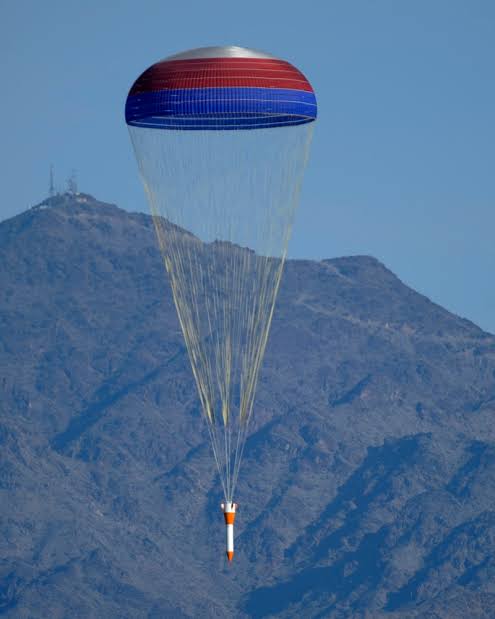
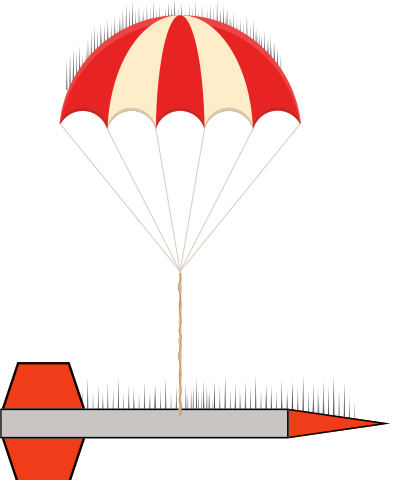
Weight pulls the rocket down. An open parachute produces upward An aerodynamic force opposing motion through the air. as it moves down through the air. As the rocket falls faster, drag increases. When upward drag balances weight, there is no net vertical force and the rocket continues down at roughly constant speed. This is its A steady falling speed reached when upward drag balances downward weight..
A larger canopy generally gives more drag at the same speed. With a larger canopy, a rocket of the same weight reaches that balance at a lower descent speed.
Descent speed and drift
A larger parachute gives the rocket more time to drift sideways in the wind. Compare canopy sizes for the same rocket and look for a landing speed, flight duration and landing area that work together.
5–8 m/s is a comparison range for a small school rocket in a simulation. Check what that speed means for your rocket, its payload and the ground it will land on. Use the real parachute and rocket mass in OpenRocket.
-
SmallFaster descent · less drift
-
MediumA balance of descent and drift
-
LargeSlower descent · more drift


Protecting the payload
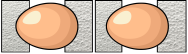
It is common in model rocketry competitions to carry a delicate The cargo a rocket carries, such as an egg, a scientific instrument or a satellite., such as an egg, that must survive the flight. See the egg payload guide.
In industry and high-power rocketry, rockets transport payloads to high altitudes. Space launch vehicles carry them into space. An egg-carrying competition simulates the same idea of transporting cargo safely. See our university climate payloads.

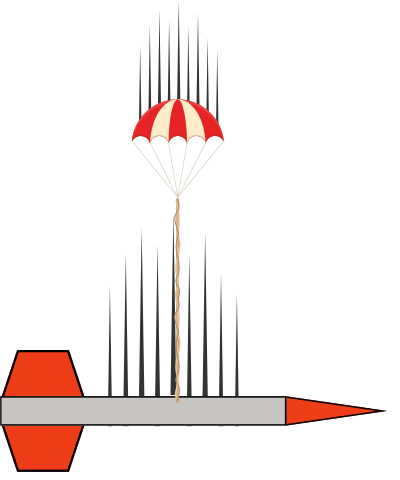
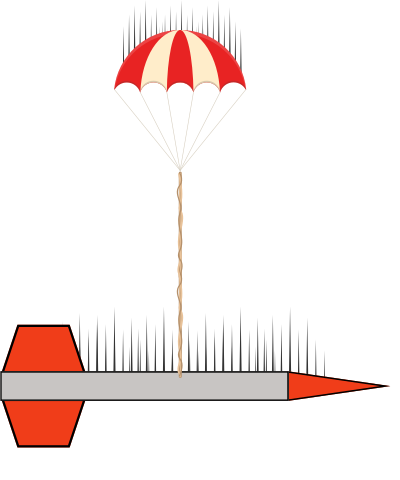
Egg protection has two jobs: hold the egg in place and cushion the forces during acceleration, parachute opening and landing. Padding spreads contact over the shell and gives the egg more distance to slow down. A hard point can crack the shell even when the rocket looks undamaged.
Good packing and a controlled landing speed work together. Allow room for the cushioning and make it easy to remove the eggs for inspection. See egg protection for more on fitting and testing it.
Drop testing
A A controlled test in which a protected payload is dropped from a measured height. lets you compare ways to protect the payload. To estimate the drop height for a speed from your simulation, use h ≈ v² ÷ (2g), where h is height in metres, v is speed in m/s and g is about 9.8 m/s². A speed of 6 m/s gives about 1.8 m in this model.
The calculation starts from rest and ignores air resistance. A real landing may hit at an angle or onto a different surface. Start with a safe substitute payload and compare one change at a time.
After landing
Watch where the rocket lands and wait for the Range Safety Officer: the person responsible for safety in the launch area and for approving a launch. to open the range before retrieving it. Leave it for the organisers if it lands in a dangerous place. Check the airframe, canopy, cords and payload before preparing another flight. A successful recovery leaves the rocket fit to fly again after replacing consumables such as the motor and disposable wadding.